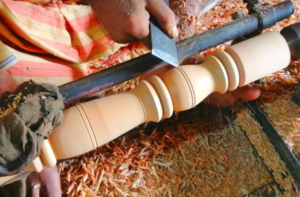
 Many books have been written about woodturning, so this article is simply an introduction to a truly fascinating craft.
Wood is such a rewarding material to work with. There are so many different woods, each having their own characteristics….colour, grain, knots, workability. These features enable beautiful artefacts to be created.
Safety Guidelines
Do not cut corners with safety equipment….it will make turning more enjoyable if you look after yourself and your workspace.
-
Eyes. You must protect your eyes from dust and flying splinters. Shatterproof glasses with side shields are a must.
-
Clothing. Hard wearing protective clothing, along with strong shoes and ear defenders are a great investment.
-
Ventilate your workshop and collect dust. You should also remember to wear a respirator.
How to Choose a Lathe
Lathes fall into three groups…..free standing….bench mounted……. mini lathes. Having chosen your group you have to decide on its ‘capacity’ or the distance between the centres. The minimum distance is 30 inches with 36 inches being the best distance for most popular projects.
The other important dimension is the swing, which is the distance between the bed and the headstock. It should generally be 9 inches.
Purchasing a heavy (cast) lathe rather than a fabricated one has the advantage of reducing vibration, which is the woodturner’s worst nightmare. The other side of the coin is that a cast lathe is more expensive and is heavy to move around.
Before You Start
-
Position your lathe at waist level on a sturdy bench.
-
Ensure your tools are in good condition and sharp.
-
Start the lathe….is it running smoothly with no vibration?
-
Keep your workspace neat and tidy.
Woodturning Methods
Spindle
The grain of the wood block to be turned runs parallel to an imaginary line drawn through the centres.
Whilst the workpiece is rotating clockwise, the operative removes material with a gouge. This method is used to make items like bedside lamp bases, chair legs and flower holders.
Faceplate turning
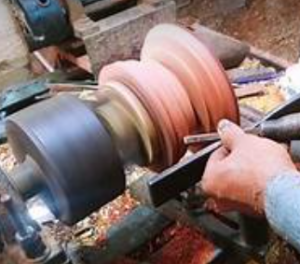 In faceplate turning the tool is fixed to the faceplate and the grain of the wood to be turned is at right angles to the axis of the lathe. The workpiece is attached to the faceplate with its grain at right angles to the lathe’s axis.
The Best Wood For Beginners
Birch
-
Affordable and easily sourced
-
Light coloured with dark streaks
-
Best for chair legs, spindles and rails
Cherry
-
Easy to turn. Popular for bowls
-
Fine grain which is good for sanding
-
Darkens after turning and with age
Horse Chestnut
-
Popular for turning fruit bowls as the wood holds moisture
-
Only disadvantage is that it cracks as it dries
Maple
-
Attractive grain pattern
-
Maple is a stable wood which does not crack easily
-
Popular with wood turners
Pine
-
One of the softest and cheapest woods
-
Sap is a problem. You may have to clean your tools frequently
Poplar
-
Relatively soft wood which can be difficult to stain
-
May have to use conditioner before staining
-
Cheap wood which is good for a beginner.
Common Tools
-
Roughing gouge: Removes bulk material quickly.
-
Bowl gouge: Designed for shapimg and hollowing bowls.
-
Parting tool: Cuts off sections and makes precise grooves.
-
Scraper: Smooths surfaces and refines shapes.
-
Spindle gouge: For detailed shaping and coves.
-
Calipers: Measures thicknesses and diameters accurately.
Preparing the wood for turning
-
Make sure there is no metal embedded in the wood. A hand held metal detector is a good investment.
-
Check for bumps and growths, possibly where the tree has grown round a nail or wire.
-
Cut rounds as soon as possible after felling to reduce the chance of splitting.
-
If you are drying green wood yourself, seal the ends to reduce the chance of splitting whilst in storage.
How To Turn Wood
Video tutorials are the best way to learn the skills required to become an expert woodturner, apart from one to one tuition. Here are a few videos to choose from, plus a creation from Jack Mack to inspire you to try something different……
Your First Go On A Wood Lathe from Richard Raffan
Free Online Woodturning Courses from Hope Woodturning
Amazing Results From Waste Wood from Jack Mack
Filing and finishing
How to improve
Associations
Courses
🎨 Finishing Techniques
Finishes enhance both the appearance and durability of turned pieces:
-
Sanding: Progressively finer grits for a smooth surface.
-
Oil finishes: e.g., tung oil, Danish oil — penetrate and enrich the grain.
-
Wax or shellac: Adds shine and protection.
-
CA (cyanoacrylate) finish: Common for pens and small items, very durable and glossy.