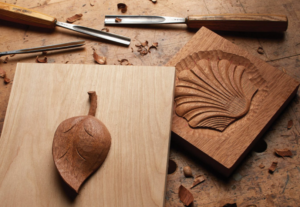
The Origins of Wood Carving
Wood carving originated many millenia ago with the carving of essential items like bowls, goblets and cutlery. Wood was also used for weapons such as spears and tools for farming. Carving tools were made from flints and iron until the invention, by chance, of steel. Steel, which is made from the introduction of carbon to iron, originated in Anatolia (modern day Turkey) in around 1800BC.
The manufacture of steel was a laborious process in those days, so it was many years before the technique spread throughout Europe. However by the time that magnificent cathedrals and churches were being built the wood carvers would have used steel knives.
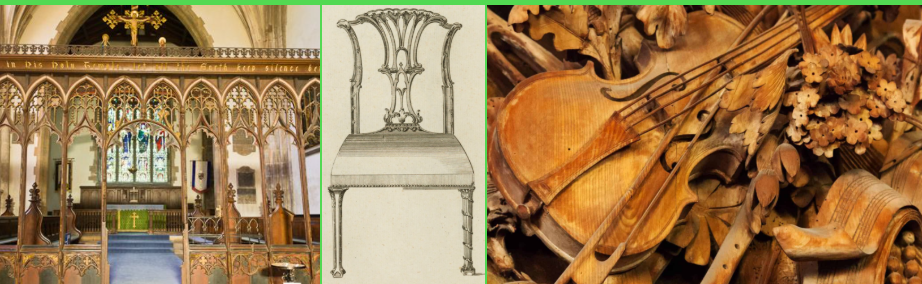
The heyday of wood carving came with master craftsmen like Grinling Gibbons (1648-1721) and the furniture maker, Thomas Chippendale (1716-1779). It wasn’t until 1856 that the first inexpensive method of producing steel from molten iron ore was invented by Henry Bessemer.
Types of Wood Carving
Whittling
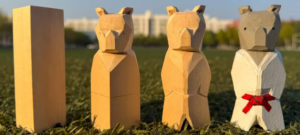
Whittling is the cheapest form of wood carving. Let your creative imagination run riot with just a knife and a scrap of wood as your props. Whittling is very therapeutic enabling you to relax, express your creativity and make useful objects.
Video Step by Step Beginners Whittling Tutorial
Shallow Relief Carving
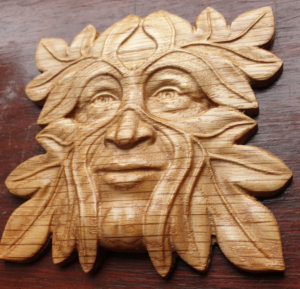
This type of carving is the simplest way to start. You use gouges to lower the background, which gives the appearance of the carving being raised off the background. There are two ways to achieve this effect. Firstly you can lower the entire background or, secondly, you can remove the wood at an angle close to the design.
Applied Carving
In this method you use a band or scroll saw to cut out the outline of the design. Once the carving is completed it is glued to a temporary backing board. This technique can be used as a design on the top of a jewellery box, for example.
Chip Carving
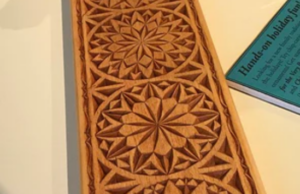
A stab knife with a short blade and a small amount of bevel is used for chip carving. Chip Carving has two variations–geometric and freeform.
Geometric Chip Carving
This type of design features recurring patterns like rosettes and decorative borders. The principle cut is a three cornered triangular shape similar to a pyramid. This cut is often complemented by plunge and slice cuts.
Free Form Chip Carving
As the name implies Free Form Chip Carving is more fluid using curves and straight lines. At first glance these cuts look like long continuous cuts but actually they are made up of a series of triangular pyramids.
Video
Quick Start Chip Carving Part 1
Carving in the Round
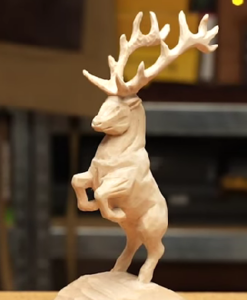
This type of carving transforms a block of wood or blank into a 3 dimensional object which has a life-like quality.
To produce the shape, the outlines or elevations must first be drawn onto the front, back and sides of the blank.
Video
How to Carve Animal Figures: A Beginners Guide
Spoon or Bowl Carving
The tools required for spoon carving are an axe, a straight knife and a bent/hook knife.
The axe, which is used for roughing out and creating blanks, should have a round edge and a flat bevel.
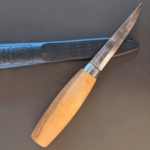 A straight knife for shaping the spoon.
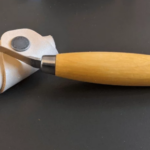 A bent or hook knife for hollowing out.
Videos
How to Carve a Spoon
How to Carve a Small Bowl
Flat Plain Carving
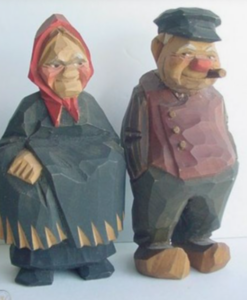
This style of carving originated in Scandanavia in the 17th century when Dalecarlian (aka Dala) horses were carved in villages in Central Sweden. The distinctive feature of these horses is the way they were carved in large flat planes. Very little sanding is carried out, so the tool marks can be seen in the completed piece. Through the years Flat Plain Carving has been used to create small character figures.
Video Whittle a 2 inch Man
What type of wood should I use for carving?
The characteristics of several popular woods are listed below……
Basswood is ideal for beginners.
White Willow is soft and easy to work for beginners.
White Pine is best suited for carving in the round or whittling. It should not be used for chip carving.
Butternut Best for relief carving. It has an attractive grain structure and colour. It doesn’t crack very easily and holds detail well.
Maple Most commonly used hardwood for carving. Especially suited for carving with a Dremel.
Aspen Ideal for beginners. Soft wood, which is resistant to splintering and is robust. Cuts easily and has a beautiful grain structure.
Cherry Falls between a soft and a hard wood. Is solid, stable and long lasting. Only carve if you are experienced.
Woodworking Magazines
Popular Woodworking
Wood Carving Illustrated
WOOD Magazine
Fine Woodworking
These magazines have a treasure trove of articles and videos on every aspect of woodworking.